

The Program degrees build on the unique definition of sustainability at UNCG, where “Academics, operations, and outreach are conducted with careful attention to the enduring interconnectedness of social equity, the environment, the economy, and aesthetics.” Our B.A. and M.S. require electives in each of those four areas: society and equity, natural science of the environment, economics and development, and ethics and aesthetics.
The Environment & Sustainability Program has a long and varied history at UNCG, and we welcome students from all walks of life with diverse interests and goals to make the world a better place for all. The Program’s founding members and alumni remain an integral part of the Environment & Sustainability legacy and network, and we have an impressive and wide-ranging Advisory Council of individuals who participate in governance and teaching for the Program.
Leadership Team

Stay in touch
Follow us on social media, or contact us at evs@uncg.edu.
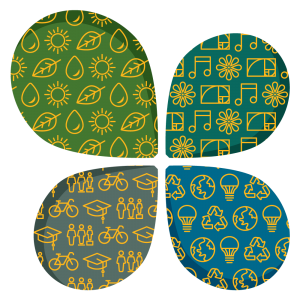
A Note About Our Logo
The stylized four-leaf clover above represents the four areas of focus for our programs: environment and ecology (upper left), equity and justice (lower left), development and economics (lower right), and ethics and aesthetics (upper right). All are interconnected, as they are described in UNCG’s definition of sustainability: “the enduring interconnectedness of social equity, the environment, economy, and aesthetics.” The environment leaf is the largest to reflect the foundational role of the planet in supporting humans. Equity is characterized by fairness, access, and justice. Economics is about better systems of exchange on a finite planet. Esthetics involves how we perceive the world and work for good culture that leads to better quality of life.
EVS News
November 12, 2025
The Ins and Outs of UNCG Sustainability
Many students become experts of earth-saving habits by making sustainability their major, minor, bachelor’s, or graduate degree. “…

June 21, 2022
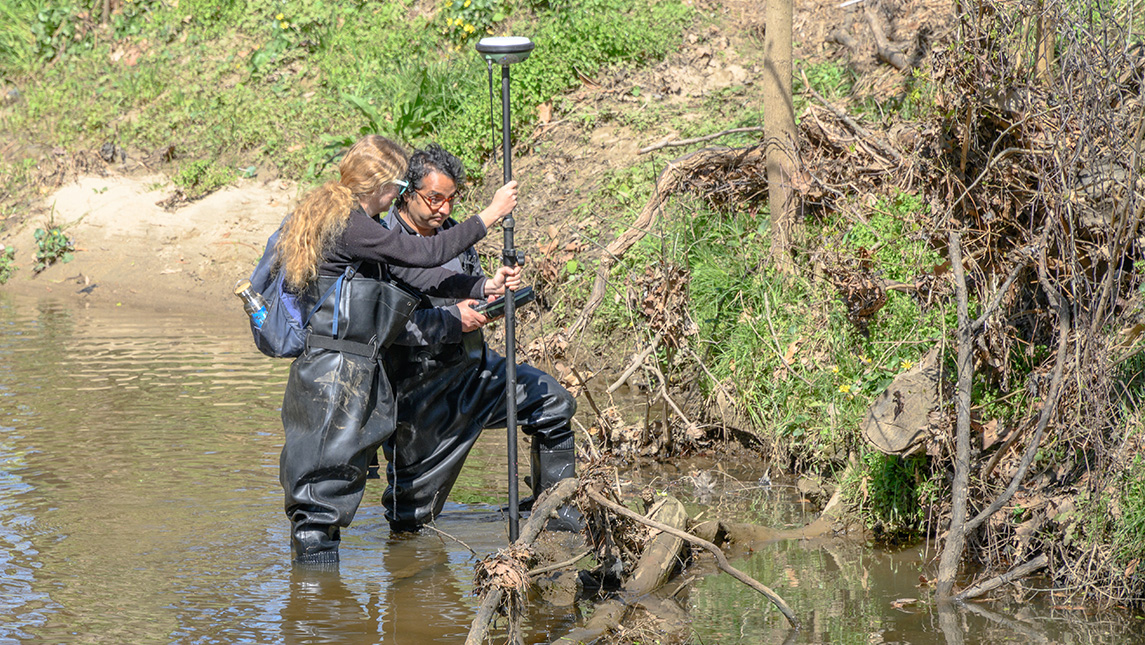
Cape Fear watershed project makes a splash across disciplines
Greensboro, known as the Gate City, is a hub for transportation, culture, and ideas. It’s also uniquely situated in the headwaters…

June 1, 2022
UNCG receives top ranking for sustainability master’s program
UNC Greensboro’s Master of Science in Sustainability and Environment (MSSE) program has been ranked number 10 in the nation for be…