Cape Fear Watershed Project
Watersheds for Place-Based, Experiential Education
Funded by the “Humanities Initiatives” of the National Endowment for the Humanities (2022-24)
The Cape Fear Watershed Project (CFWP) uses the humanities to connect natural- and social-science studies of a major bioregion of North Carolina. Our environmental humanities initiative emphasizes collaborative, place-based interdisciplinary teaching and experiential learning to benefit students and our watershed communities.
Watersheds provide a natural organizing principle to study people and places: they integrate space, time, biophysical systems, and humans, while also encompassing the complex interactions of biophysical and social systems. The Cape Fear River is one example of how people interact with place: its watershed (the most significant one entirely within North Carolina) offers opportunities to explore topics concerning human interactions with the environment and social manifestations related to place. The CFWP uses the watershed to reflect on social connections and human relationships in and with nature, all with the aim of creating a shared sense of community that leads to greater responsibility for the human and non-human life in our region — and throughout the planet.
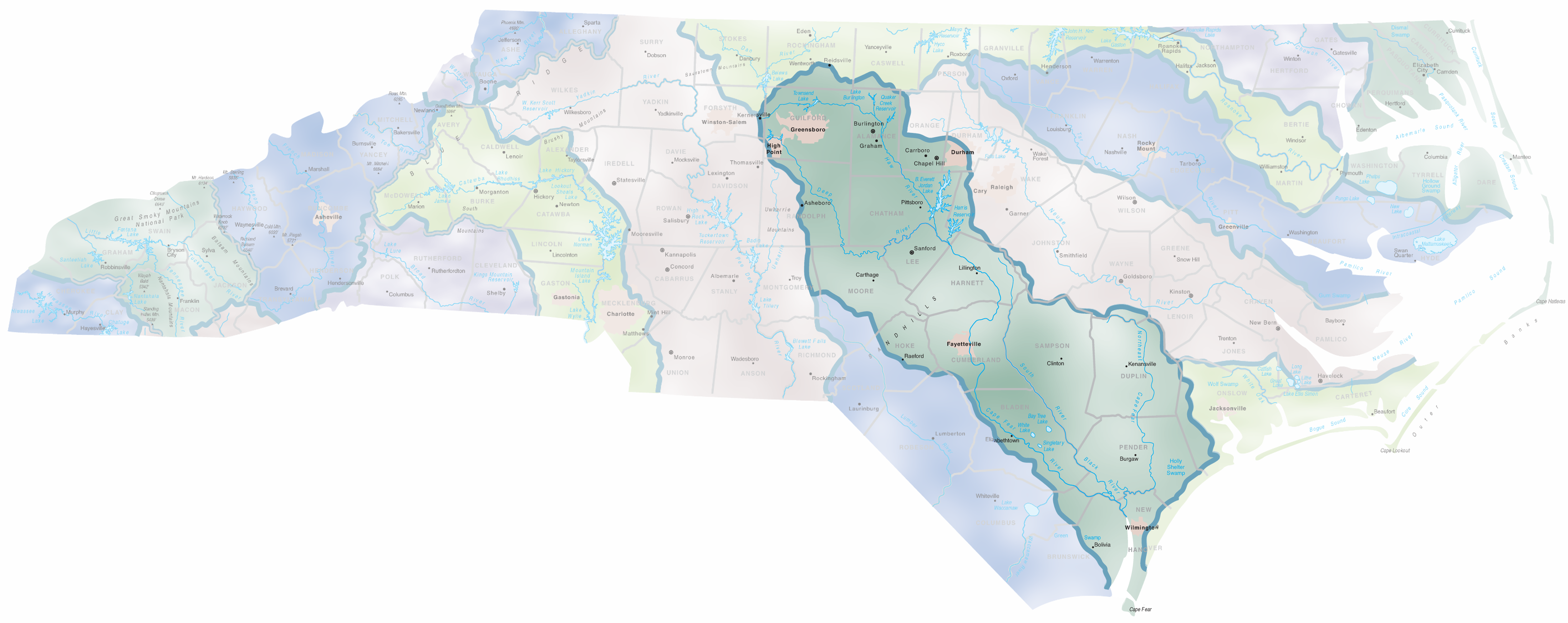
The CFWP is an ongoing effort that focuses the efforts in curricular, research, and outreach of the UNCG Environment & Sustainability Program. Between 2022 and 2024, we were funded by the NEH. Our work continues and is chronicled on this website, along with archives of news and past accomplishments, some of which include:
- A CFW story map that is a “living document” and will continue to be updated with student, faculty, and community materials.
- Curricular developments in the M.S. in Sustainability & Environment, an online program that benefits from place-based education.
- An innovative summer field course (“Cape Fear Watershed,” GES 670), designed especially for that M.S. program.
- An innovative “Books to Boats” faculty development workshop in May 2023.
- A new non-profit, the Deep River Riverkeeper.
(Further resources and links are provided below.)
Our Team
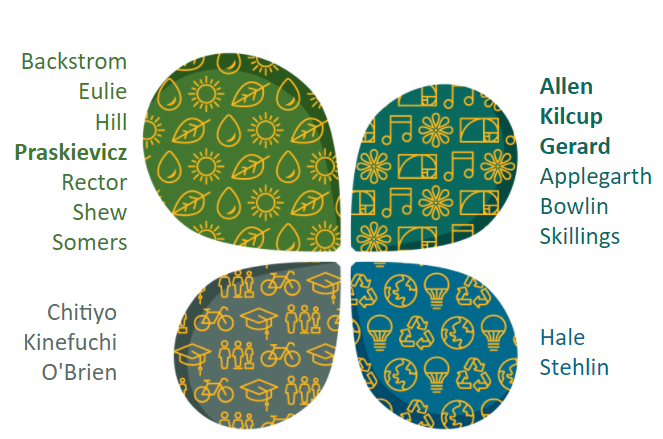
The CFWP is led by UNC Greensboro’s Environment & Sustainability Program. To illustrate our original (2022-24) faculty members’ interdisciplinarity, we use the Environment & Sustainability Program’s logo of the four-leaf sustainability clover to organize our members by last name: the top left (largest) leaf represents environment, while the top right illustrates aesthetics (humanities); the bottom right is development and economics, while bottom left is social justice. We understand sustainability as defined by UNCG in 2009 as “the enduring interconnectedness of social equity, the environment, economy, and aesthetics.”
The CFWP uses humanities methods (e.g., history, ethics, reflection, creativity, etc.) to craft a model curriculum regarding topics (places, environments, watersheds) that are normally the purview of the physical, natural, and social sciences. The CFWP welcomes guests who observe and participate. Furthermore, the CFWP is proud to collaborate with organizations whose work focuses on the Cape Fear watershed (listed below).
NEH Project Video Overview
Iconic Places in the Cape Fear Watershed
(photo gallery restoration coming)
Resources
Watersheds are land areas that collect precipitation and drain to the ocean. See more at NOAA.
StoryMaps, a product of the GIS company ESRI, are interactive web maps that allow for virtual “tours” of a mapped landscape, integrated with text, photos, and videos. The ability to integrate literary and artistic content with spatial data allows for humanities content to be linked to place, the overarching goal of the CFWP. Accessible to anyone, StoryMaps will be a living resource for faculty, students, and the public that is continually developed and expanded. To follow the progress of the CFWP, visit our StoryMap.
Click here to view our reading list and supplementary bibliography. The original CFWP read and discussed Philip Gerard’s Down the Wild Cape Fear: A River Journey Through the Heart of North Carolina (University of North Carolina Press, 2013).
Click here to read an UNCG News article (June 2022) about the CFWP.
Further links:
- North Carolina Environmental Education (NC-EE)
- NC-EE River Basin Program
- NC Department of Environmental Quality “It’s Our Water” Curriculum
- NC Department of Environmental Quality: Drinking Water Protection Program
- NCDOT: Stormwater Management Program
- NCDHHS: GenX in the Lower Cape Fear River Basin
- Article: “Cancer fears plague residents of US region polluted by ‘forever chemicals'”
- Augsburg River Semester: 100 Days on the Mississippi River
- Related projects:

